The base system is a usable teaching product. Select only the extra capability your curriculum and site require.Typical lead time: 8–12 weeksDelivery, site services and final manufacturing dates are confirmed with the formal quotation.
IES does not hold this product as finished stock. Manufacture begins after the order is accepted and the configuration is signed off. The stated lead time runs from that point and is confirmed in the formal quotation.
Commercial information
What to expect when ordering
Availability
Made to order
Manufacturing lead time
8–12 weeks, starting after order acceptance and specification sign-off
Published pricing
Budget prices exclude VAT. The formal quotation confirms the selected configuration and final price.
Delivery and installation
Quoted separately where transport, positioning, utilities, specialist installation or commissioning are required.
Build the right system
Optional extras
The base price includes the working core system, standard controls and guarding, a core practical-teaching pack and pre-dispatch functional testing. These options let a college add capability without paying for it as standard.
Advanced fault-insertion pack
From £950 excl. VAT
Adds further tutor-controlled electrical, sensor, mechanical or process faults appropriate to the system.
Additional curriculum route
£750 per route excl. VAT
A further qualification-mapped activity set, lecturer guide and assessment evidence pack.
On-site commissioning and staff training
From £1,250 + travel excl. VAT
Installation checks, operational handover and practical familiarisation for teaching and technical staff.
Three-year support plan
From £1,450 excl. VAT
Scheduled technical review, priority remote support and an annual resource-update entitlement.
Delivery, specialist lifting, utilities, building work, third-party licences and installation are quoted separately where required.
Included in the base system
A complete teaching product, not an empty frame.
The complete working core equipment described in the product overview and technical specification
Standard operating controls, protective devices and guarding appropriate to the agreed design
The core learner activities, lecturer guidance and assessment materials listed on this page
Assembly, pre-dispatch inspection and functional acceptance testing
Operating documentation and a remote handover session
College preparation
Likely site requirements
A suitable teaching or workshop location with the operating space and safe clearances agreed in the final specification
A suitable electrical supply and local isolation arrangement; voltage, current and connector requirements are confirmed before manufacture
Safe delivery access, door widths and any lifting or positioning requirements confirmed before dispatch
Workshop-floor capacity and delivery access suitable for a mobile or floor-standing engineered system
These are planning requirements. The final utility, space, access and safety requirements are confirmed for the ordered configuration before manufacture.
Made-to-order process
From teaching need to working system.
Discuss the requirementCurriculum, learner numbers, intended practical work and available space.
Agree the configurationCore system, optional modules, resources, site requirements and responsibilities.
Accept the quotationThe specification, price, payment schedule and confirmed lead time form the order.
Manufacture the systemIES or an approved manufacturing partner builds the ordered configuration.
Inspect and testPre-dispatch functional acceptance checks are completed and recorded.
Deliver and commissionThe agreed delivery, installation, handover and staff training are completed.
Product overview
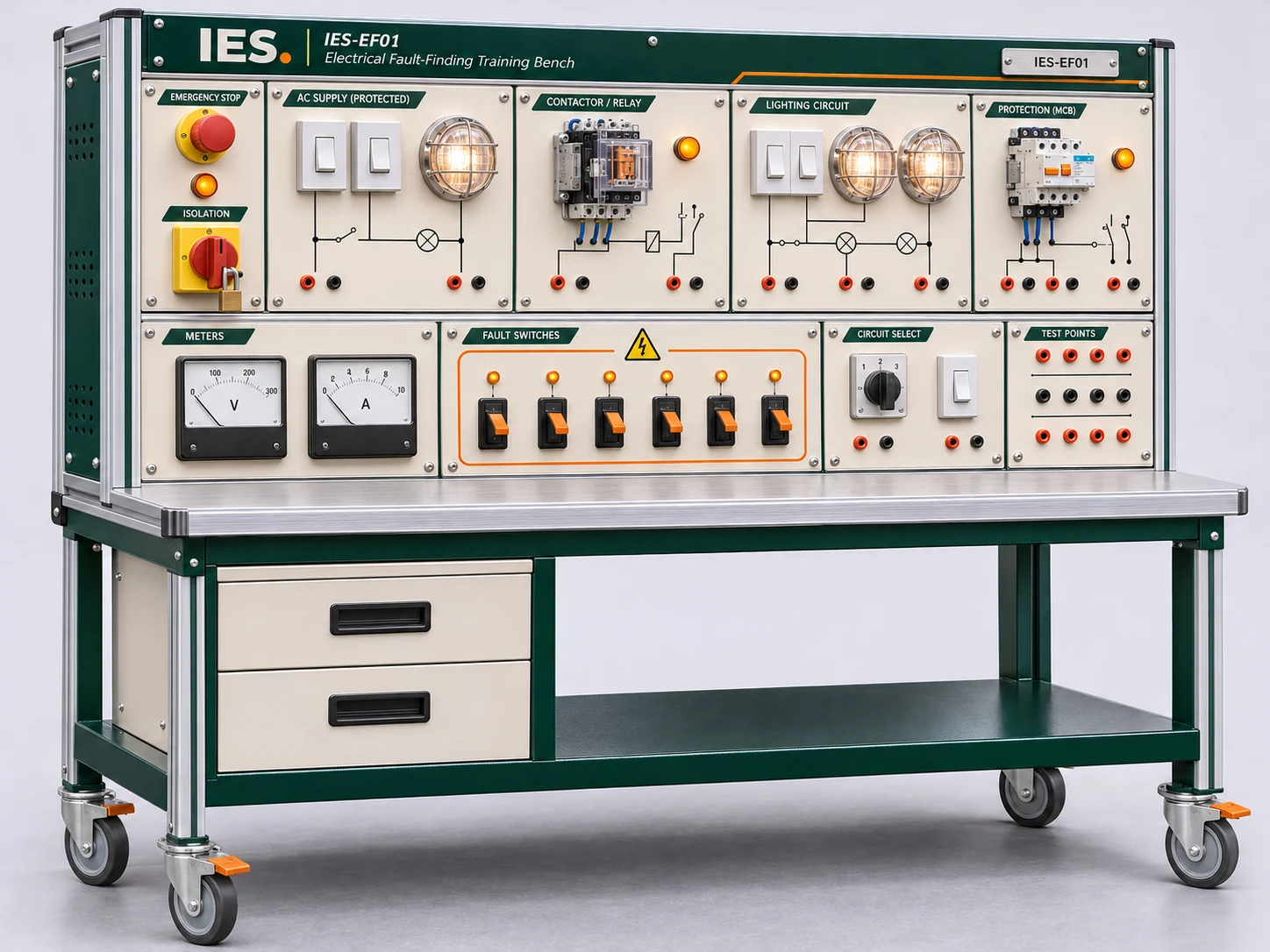
The ET02 extends electrical fault-finding into interconnected control, protection, indication and load circuits, with instructor-selected faults and protected measurement points.
Technical features
Extra-low-voltage lighting, relay and control circuits
Instructor-operated open, short and high-resistance faults
Protected test points, isolation controls and current limiting
Circuit diagrams and progressive diagnostic scenarios
Learning applications
Plan a safe fault-finding sequence
Select and apply electrical measurements
Interpret symptoms across interconnected circuits
Record evidence and justify repair decisions
Qualification context
EAL and City & Guilds engineering programmes
Electrical maintenance apprenticeships
T Level and BTEC engineering study, subject to local mapping
Digital integration
IES Electrical Fault-Finding Laboratory
Downloadable diagnostic records and assessment evidence
Included teaching resources
Electrical fault-finding practical pack
Lecturer setup and fault schedule
Learner evidence workbook
Assessment scenarios and solutions
Curriculum mapping requires confirmation.
Qualification references describe potential teaching relevance, not awarding-organisation endorsement or automatic compliance with a current specification. Educators should verify the applicable specification, centre arrangements and local risk controls.
Quotation request · ET02
Configure this system for your learners.
Share the intended application, approximate quantity and procurement timescale. IES will review your requirements and contact you to agree the configuration and prepare a formal quotation.